How
does a sundial work?
A sundial indicates the hour by means of the shadow thrown by the tip of a style or gnomon on a graduated surface marked with hour lines and a calendar.
All sundials have the following structural elements.
- Gnomon or Style
- Surface of the clock
A very important concept to note, is that commonly used civil or legal time is only approximately equal to true solar time, that is measured by a solar clock. This is due to variation in the movement of the sun in the sky at different times of the year and also to agreements that governments adopt to standardize timekeeping. The difference between civil time and true solar time can be adjusted for by using the "equation of time". (See Time corrections).
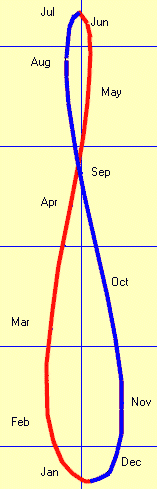
The equation of time takes the shape of the analemma, a roughly figure eight shaped curve that graphically indicates this difference between true solar time and clock time. Each half of the figure eight corresponds to a half-year period (summer-autumn and winter-spring). The maximum deviation is about 16.5 minutes. If a sundial with closely spaced hour lines (15 min or 30 min) is used, reading may be difficult as these hour lines may overlap with the analemma. In this case, an option is to build two more easily read sundials, one for each half of the
year.