The principles for the design of a solar clock have been known since ancient times.
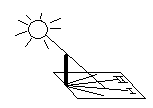
An observer notes where the suns shadow of a fixed pointer falls at a given moment on a surface. The changing location and length of the shadow corresponds to the suns daily motion through the sky. In this way, the motion of the sun can be permanently marked on the surface and used to tell the time of day. Therefore, to build a solar clock we only have to mark the position of the shadow that a fixed object casts at different times during the day.
This method will produce an accurate solar clock for one particular day but will not be as accurate for any other day of the year. As the months go by, the error difference between the sundial clock and the exact wristwatch time will continue to increase. To solve this problem it is necessary to use a more general method and substitute the initial marked hour lines with other curves or charts added to the
clock.


