
This is a type of plane clock, with the plane forming an angle of inclination with a vertical plane
at the location. Oblique sundials can either be aligned or non-aligned with the local meridian. The shadow produced by the tip of the gnomon on the oblique clock plane is used to read the hour and the day.
This sundial includes a calendar, and the proper corrections for longitude, the equation of time, and daylight savings time, in order to obtain the correct civil time.
The geometric dimensions of the clock used in the program are input in the screen DIMENSIONS.
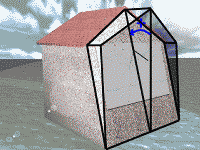
INCLINATION OF THE WALL (WALL SLOPE)
The sign convention used for the inclination of the wall is as follows:
POSITIVE: When the angle of inclination is toward the wall (normal).
NEGATIVE: When the angle of inclination is away from the wall (overhung).
A vertical sundial is a special case of the oblique type, with an inclination of 0º.
A horizontal sundial is a special case with an inclination of +90º.
An equatorial sundial is another special case where the inclination of the clock plane is parallel to the plane of the earth's equator. In this case, the perpendicular gnomon aligns with the celestial polar axis. The curves that form the calendar are circular arcs. This is a particularly common type.
The geometric dimensions of the clock used in the program are input in the screen DIMENSIONS


